High-intent pages decay while teams keep chasing new keywords.
CMS-connected SEO/GEO operations
Recover lost SEO traffic from old content before creating more.
QACE connects to your CMS, finds decaying pages, creates refresh and linking plans, gates publishing, and proves lift at Day 30, Day 60, and Day 90.
100k+pages processed in internal SEO experiments
Day 30/60/90measurement built into every loop
Human gateapproval before CMS publish
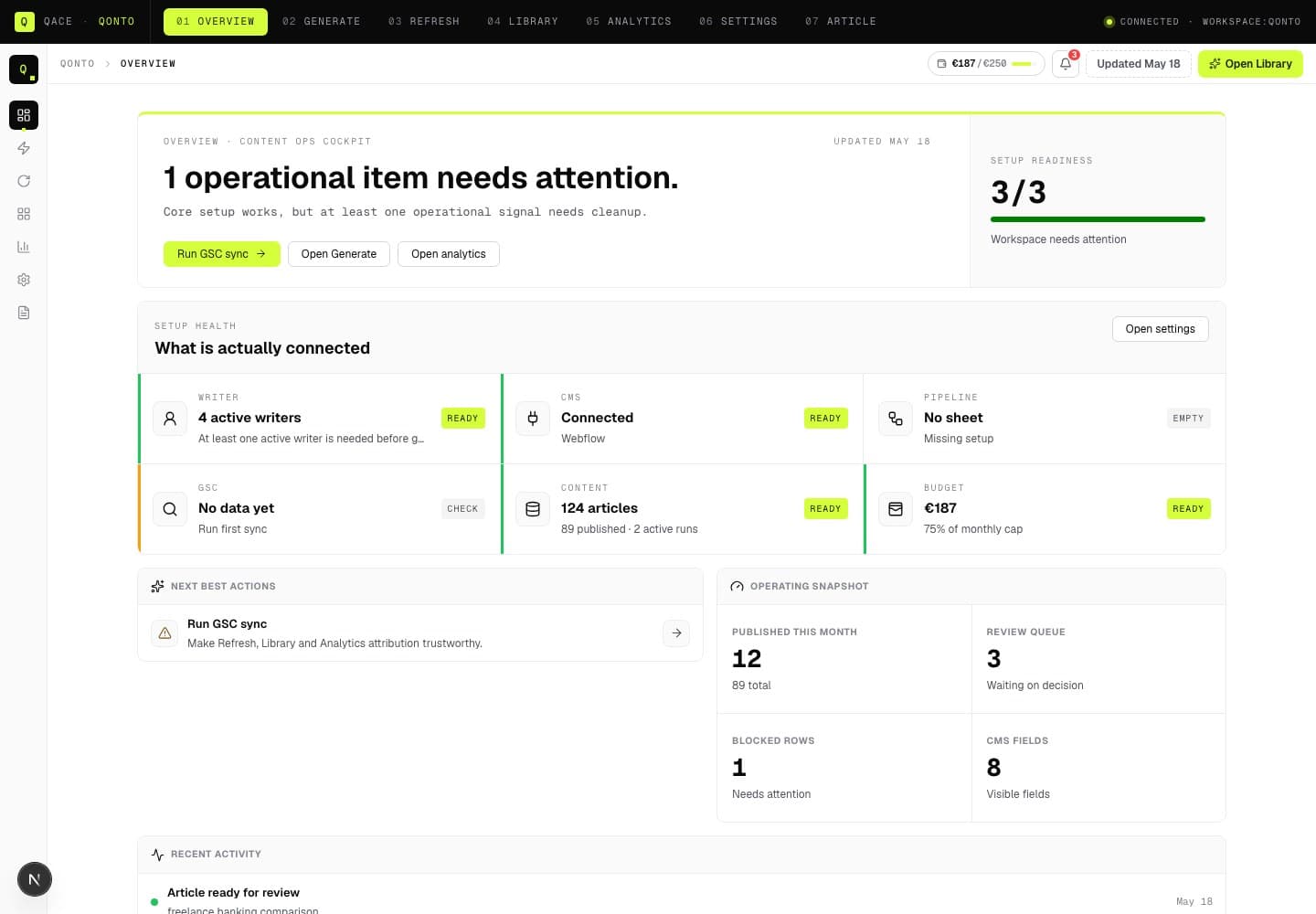
Real cockpit preview.Overview readiness, CMS status, GSC sync, next actions, and operating snapshot.
The problem
Your team does not need more disconnected AI articles.
It needs an operating loop for content decay, CMS publishing, internal links, sources, approvals, and measurement.
GSC, CMS, briefs, Notion, Sheets, internal links, and approvals live in different places.
Mapped fields, images, metadata, schema, authors, and rollback paths are easy to miss.
Product walkthrough
Inspect the operating flow before you book the audit.
Open the cockpit preview to see the exact sequence: Overview readiness, Generate brief, linking plan, Refresh diff, CMS preflight, and Day 30/60/90 measurement.
 Operator walkthroughLive cockpitSuggested flow: decay queue - brief - linking plan - CMS preflight - impact tracking
Product proof
Four product screens show how the workflow actually runs.
QACE is not a hidden automation running behind a spreadsheet. The cockpit exposes generation, refresh, article QA, setup readiness, CMS fields, images and publish gates.
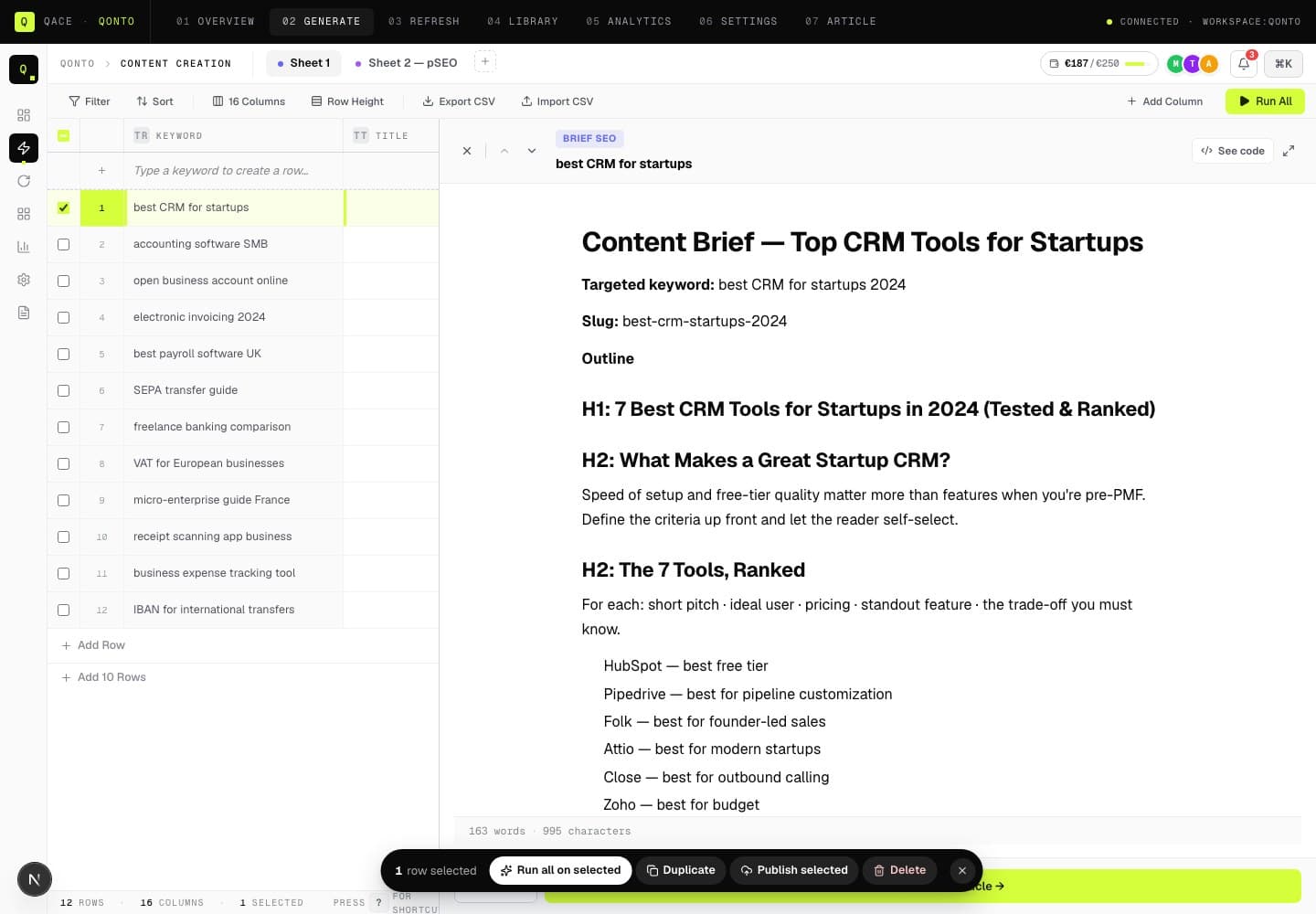
Generate
Brief and article generation stay reviewable
The spreadsheet stays operational, while the side panel exposes the brief, article, score, links, images and CMS payload.
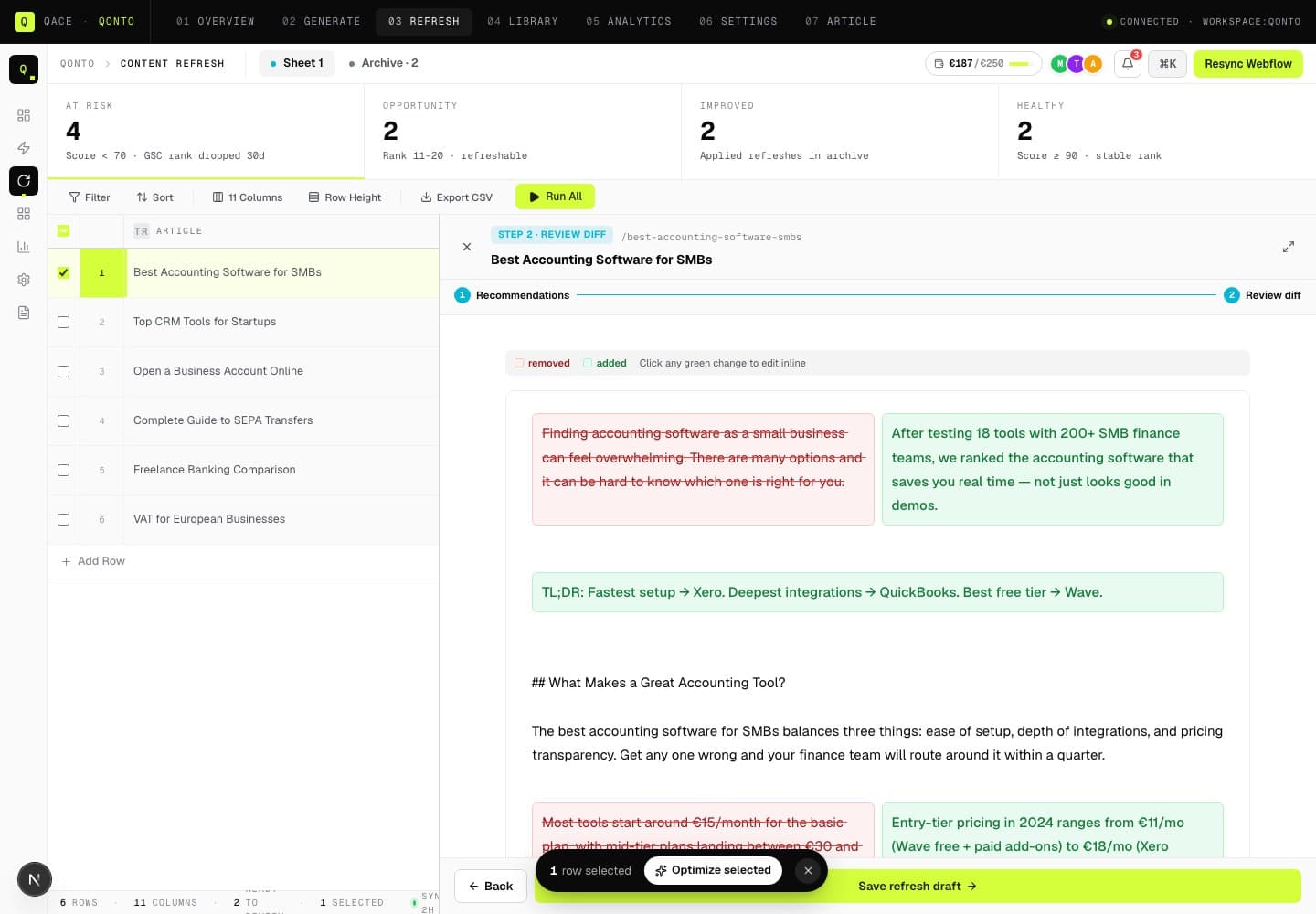
Refresh
Refresh recommendations include a real diff
Refresh is diagnostic-first: recommendations, evidence, changed passages, and approval before CMS update.
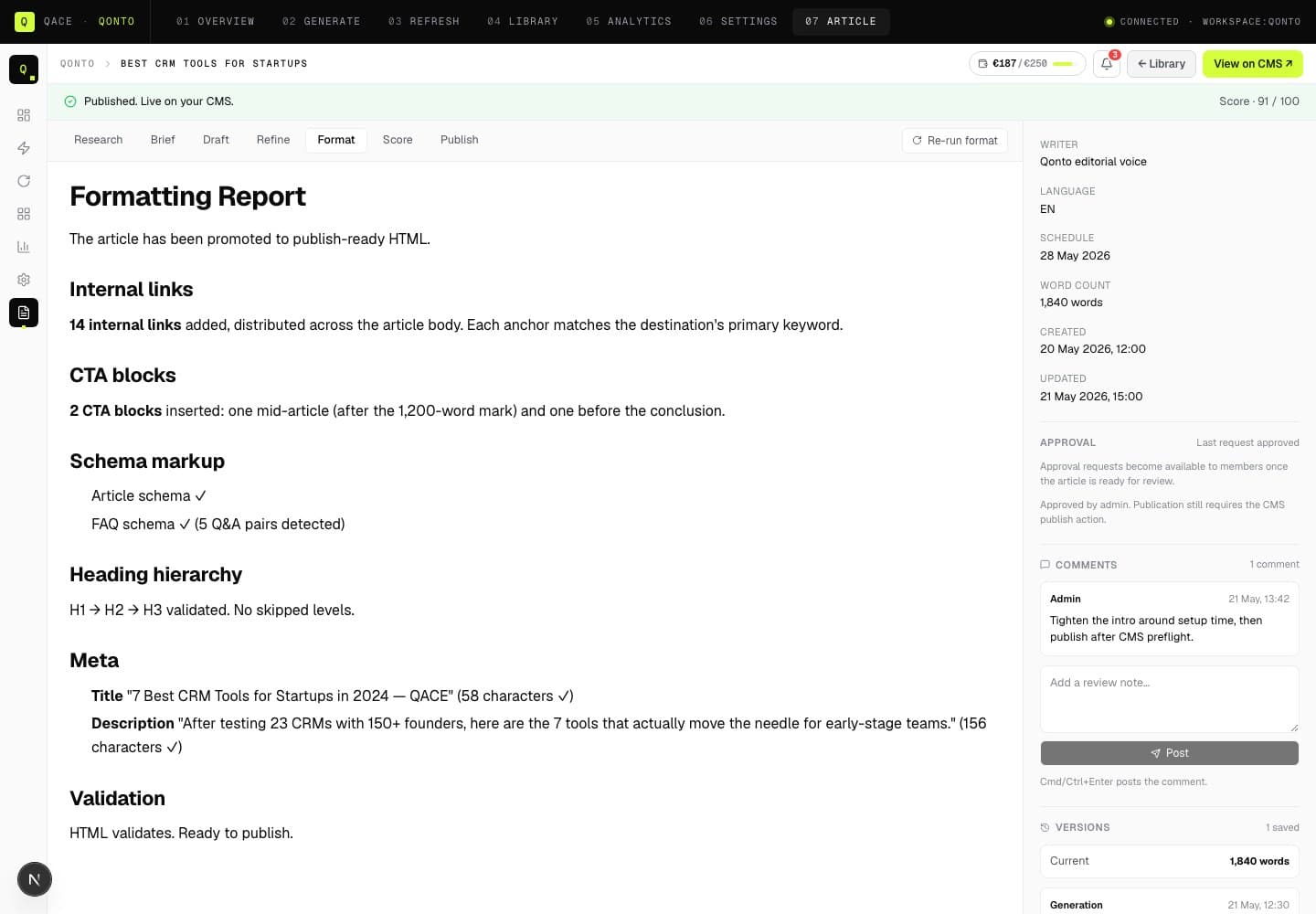
Article QA
Publish-ready HTML is checked before CMS
The article detail keeps formatting, internal links, schema, meta, comments, approvals, versions and CMS status visible.
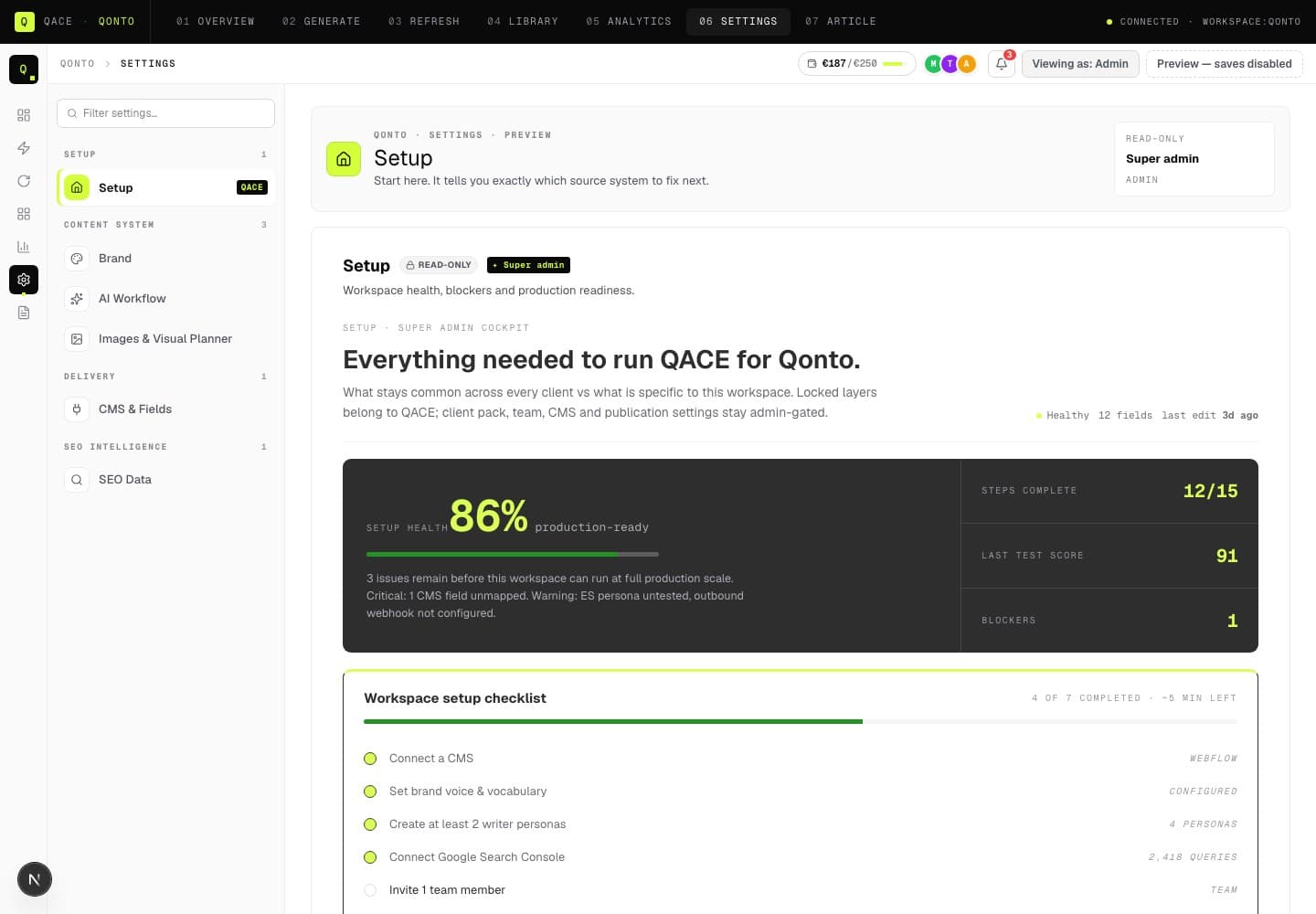
Setup
Client setup is explicit, not hidden in prompts
Admins can inspect readiness, CMS fields, AI workflow, SEO data, image planning and client-specific blockers.
The operating system
One workflow for the content jobs that usually fall between tools.
Find decaying content
QACE identifies pages losing clicks, rankings, freshness, internal support, or AI-answer visibility.
Refresh queue readyBuild the operating plan
Research, search intent, internal links, external sources, images, and CMS fields are planned before drafting.
Brief + link planGate risky actions
Admins approve briefs, article drafts, duplicate-risk rewrites, image assets, and CMS preflight.
Approval requiredMeasure the lift
Every creation and refresh stays tied to published URLs, GSC snapshots, and Day 30/60/90 attribution.
Impact trackedWorkspace readiness
CMS mapped - GSC synced - prompts tested - budget guarded
ReadyRecovery queue
Prioritized by decay, business value, intent drift, and update feasibility
18 opportunitiesInternal link plan
Parent link, sibling pages, money pages, support links, and source citations
ApprovedPublish preflight
Slug, schema, images, mapped fields, duplicate risk, and rollback path checked
Safe to publishWorkflow
From content chaos to a measurable approval loop.
QACE connects the content library, decides what should move first, prepares the work, gates risky actions, and measures the result.
Import URLs, fields, authors, historical performance, and publishing constraints.
Find pages worth refreshing, new clusters worth creating, and money pages that need support.
Run governed prompts, approvals, duplicate-risk checks, images, CMS JSON, and dry-runs.
Track lift and decide the next iteration from actual GSC and published URL data.
Use cases
The first pilot should focus on value trapped in operations.
Refresh old content
Recover traffic from articles losing clicks, rank, freshness, or answer coverage.
Create new SEO/GEO pages
Turn validated keyword opportunities into governed briefs and CMS-ready articles.
Strengthen internal linking
Add parent, sibling, money-page, and contextual links before the draft is written.
Publish safely to CMS
Map structured fields, images, metadata, schema, and rollback paths before publishing.
Best fit
Built for teams with content value already sitting in the website.
You have enough content surface for decay recovery to matter.
The ideas are known, but briefs, validation, CMS, and measurement slow execution.
Publishing requires mapped fields, images, authors, schema, and QA.
Built on 100k+ internal SEO experiments before selling the system.
The workflow was tested on real content libraries first: pages generated, refreshed, published, analyzed, broken, and corrected before being packaged for B2B teams.
+184%
Internal Day 90 sample after structural refresh, sources, internal links, visuals, metadata, and GSC follow-up.
Proof comes from the loop, not the draft.
QACE tracks the content state before and after publication, so refresh work can be judged by actual search impact instead of screenshots and opinions.
Founder-led pilot
Install QACE on one real content library before scaling anything.
The offer is intentionally narrow: audit, setup, first refreshes, first new pages, CMS workflow, and Day 90 measurement. No generic AI content subscription.
3-month pilot€3.5k-€5k setup€2k-€2.5k/month
Includes content decay audit, dashboard setup, prompt calibration, first batch, CMS preflight, refresh tracking, and operating review.
Book a demoFAQ
Fast answers before the audit.
Is QACE another AI writer?
No. QACE is a CMS-connected Content Ops system: prioritization, prompts, link plans, briefs, review, CMS preflight, refresh, and measurement.
What happens in the audit?
We review your content library, CMS constraints, GSC reality, first refresh opportunities, and whether a 3-month pilot makes sense.
Can QACE publish directly to our CMS?
Yes when your CMS supports it, but never blindly. Publishing is gated by approval, field mapping, duplicate-risk checks, and CMS preflight.
Do you replace our SEO agency or writers?
No. QACE replaces the operational drag around briefs, refreshes, sources, links, CMS formatting, approvals, and measurement.
How fast do results show?
Refreshes often show early signals between Day 30 and Day 90. QACE is built to measure that loop instead of guessing.
QACE
System operational - audit slots availableShow us your content library. We will find the first refreshes worth running.
In 30 minutes, we review your catalog, CMS constraints, existing rankings, and first opportunities. You leave with a concrete operating diagnosis.